|
Hoheria populnea and related species are known as "lacebarks" from the tough lace-like inner bark, and "ribbonwood" from the medullary rays which cut across the bark bring nutrients from the centre of the trunk or branch to the surface, giving it a ribbon-like appearance. The three species discussed on this page, Hoheria populnea, along with H. glabrata and its twin H. lyallii, form part of the "fau" network, with local names derived from or incorporating the Proto-Polynesian *Fau (Hibiscus tiliaceus), and like the original Fau having a lace-like inner bark.
Houheria populnea
Hoheria popunea is confined naturally to the northern North Island, from North Cape to Waikato and the Bay of Plenty, but is now widely cultivated throughout Aotearoa and also in the United Kingdom. Its natural habitat is in coastal and lowland forests, especially forest margins and along the banks of rivers. Nonetheless the trees seem to have a unique capacity to withstand sub-zero temperatures, enabling them to survive even the rigours of a Scottish winter. Several commercial cultivars have been developed in Aotearoa and the United Kingdom, differing mainly in the colouring and form of the foliage. The tree can reach 12 m. in height, with a trunk 30 cm in diameter and smooth, grey outer bark. When the tree is young, the leaves are of varied shapes and sizes; on mature trees they are oval, tapering to a sharp tip, serrated and often purple underneath, up to about 12 cm long. Young trees may be similar in form to the adult ones, or a tangle of thin, divaricating branches.
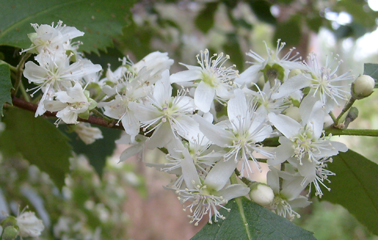
The flowers are borne in profusion, produced in bunches from the axils of the leaves. They are fragrant and well-stocked with nectar and pollen, attracting an assemblage of bees, butterflies, flies and small beetles. The individual flowers are about 2.5 cm wide and have five, evenly spaced white petals. They produce a winged fruit, illustrated to the left, with each seed-case having a single seed.
The fibre is excellent for cordage, and was plaited into ropes, nets and eel traps. It has also been used for making hats and incorporated into basket weaving. Traditionally it was also used to make light-weight summer clothing; it is not as strong and durable as harakeke, but is much lighter. Capes made from harakeke (e.g. kākahu and pōkeka) were sometimes lined with houhere bits. Houhere ropes also had a role in beating flax garments washed using uku (blue clay). Poi balls were also stuffed with houhere fibres until the advent of plastics.
The white wood is very tough and makes excellent firewood, burning easily and producing good heat.
The houhere was known to have medicinal qualities. Alan Clark (The Great Sacred Forest of Tāne, p. 299) says the bark was used as a diaphoretic (i,e. to produce sweating), and also to help sooth sore throats. He notes (p. 309) that the butts of harakeke leaves "were finely sliced with the inner bark of the houhere in water, and the liquid was used on burns and scalds." Also (p.334) that according to the writer Lucy Cranwell a jelly formed from soaking strips of houhere bark in water for two days was used by old people "to bathe weak, phlegmy or sore eyes". The inner bark was also used for bandaging (sometimes infused with titoki oil), and also for trussing the bodies of deceased persons
Hoheria glabrata
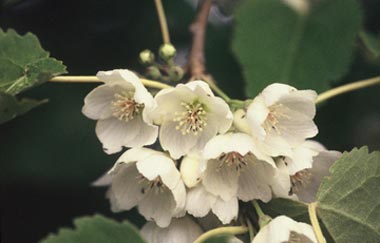
Hoheria glabrata, the "mountain ribbonwood" is found around Mount Taranaki in the North Island, and Northwest Nelson and the West Coast in the South Island, in lowland and subalpine forest to about 2,600 m. It grows to 10 m. high, with smooth, shiny leaves up to 15 x 5 cm with rounded teeth in the margins and tapering to a sharp tip, and a trunk about 30 cm in diameter. The white flowers appear in mid-summer to early autumn. They are very showy, about 3 cm in diameter, bell-shaped with five overlapping petals, borne either singly or in clusters of 2-5 flowers, with the oldest flowers innermost. The fruit capsule is wingless, unlike the winged capsules of H. populnea. The fruits are divided into 10-15 compartments, each containing a single seed. It is one of the few deciduous trees in the NZ flora; the foliage turns yellow before falling. In the South Island it is a tree of the wetter mountain slopes in the west, in contrast to the other mountain lacebark H. lyallii (whauwhi) which prefers the drier eastern slopes. It often forms large thickets on avalanche paths and the sites of old slips. In cultivation it will survive in drier conditions, but may not flower as profusely as trees in cool, damp areas.
Hoheria lyallii.
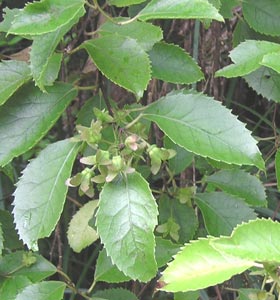
Hoheria lyallii is rather similar to H. glabrata, but is a smaller tree (up to about 6 m or so), with a trunk 30 cm in diameter and smooth, brown bark. The leaf margins have conspicuous rounded serrations, and the branchlets, flowers and bright green leaves are covered with clusters of small hairs. The flowers have wide petals, are pleasantly scented, and are borne on clusters of 2-5 with quite long stalks. Like H. glabrata, the tree loses its leaves in winter.
This tree grows in drier parts of higher altitude forests in NE Nelson, and East of the South Island main divide. .
There are further notes on the etymology of this plant name on the page for the Proto Eastern Polynesian word *fausele which gave rise to it, and the pages for *fau, whau and *fauqui. |
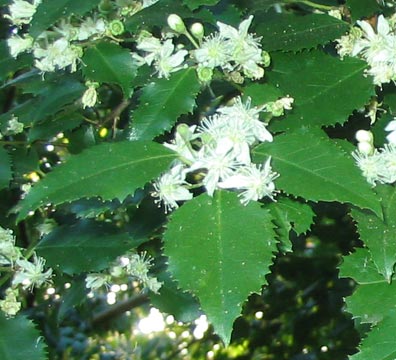
Photographs: The inset photographs are (1) flowers of Hoheria populnea, Te Māra Reo; (2) winged fruit of Hoheria populnea, (c) Peter de Lange, NZPCN; (3) flowers and foliage of Hoheria glabrata, and (4) those of H. lyallii, by the late John Smith-Dodsworth. The other photographs are acknowleged in the captions. We are grateful to the photographers for permission to use their work.
Citation: This page may be cited as: R. A. Benton (2026) "The Māori plant name Houhere and its Polynesian cognates" (web page periodically updated), Te Māra Reo. "http://www.temarareo.org/PPN-Fauqui.html" (Date accessed)
(Hoki atu ki runga -- Go back to the top of the page.)

Houhere, Hoheria populnea, Foliage and flowers.
Hutt River Trail, welington. Photo: (c) Jeremy Rolfe, NZPCN.
| 
Mountain Houhere, Hoheria glabrata, showing form of leaves.
Routeburn Track, Fiordland. Photograph: John Sawyer (c) NZPCN |
|