
PROTO-POLYNESIAN ETYMOLOGIES
*Fausele [Proto (Eastern) Polynesian]
Hibiscus variety or Hibiscus-like tree (Malvaceae).
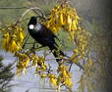
Tui
From PROTO MALAYO-POLYNESIAN *baRu, Hibiscus tiliaceus , "Beach Hibiscus" (Malvaceae).
through PROTO OCEANIC *paRu, Hibiscus tiliaceus;
and PROTO EASTERN OCEANIC *vaRu, Hibiscus tiliaceus; combined with
PROTO POLYNESIAN *sele, "snare, tie up".

Proto Polynesian: *Fausele, or Proto Eastern Polynesian: *Fauhele "A hibiscus-like tree with fibre useful for lashing"
REFLEXES IN SOME POLYNESIAN LANGUAGES:
[Niuean: Fou hele (Abutilon indicum, Malvaceae)];
Marquesan: Hau he'e (Hibiscus tiliaceus);
Hawaiian: Hauhele (Hibiscus arnottianus); Hauhele, Hauhele wai (Hibiscus furcellatus*); Ma'o Hau Hele (Hibiscus brackenridgei*); Hauhele 'ula (Kokia spp., Malvaceae)
Rarotongan: 'au'ere (Grewia prunifolia, Malvaceae);
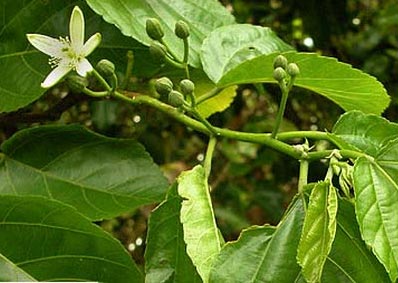
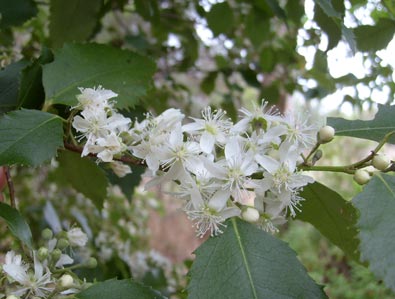
Maori: Houhere (Hoheria populnea, Malvaceae), Houi, Houhi (Hoheria & Plagianthus spp.) - Proto Polynesian *Fauqui.

Hauhele flower
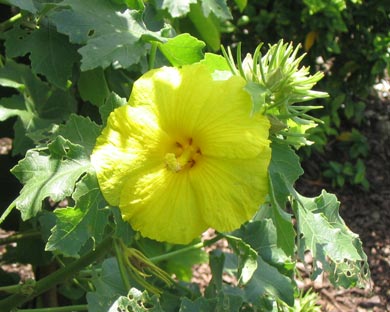
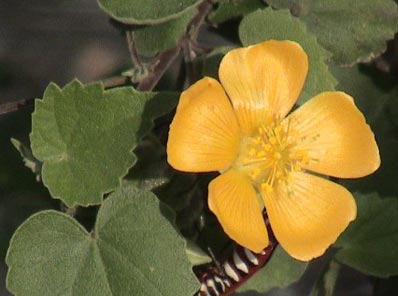
Hibiscus* brackenridgei - Ma'o Hau Hele
('Imiloa Planetarium, Hilo, Hawaii. Photo: R.B.)

Hauhele
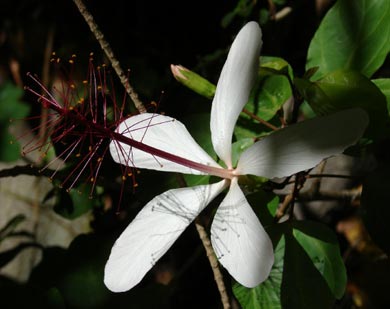
Hibiscus arnottianus - Hau hele
(Kula, Maui, Hawai'i. Photo: (c) Forest & Kim Starr)

(PARTIALLY) COGNATE REFLEXES IN SOME OTHER AUSTRONESIAN LANGUAGES
Ilocano (Philippines): bago (Hibiscus tiliaceus, "Beach Hibiscus", Malvaceae);
Tagalog (Philippines): balibago (Hibiscus tiliaceus);
Gitua (North New Guinea): paru (Hibiscus tiliaceus);
Mota (Vanuatu): varu (Hibiscus tiliaceus);
Fijian: vau (Hibiscus tiliaceus).

RELATED WORDS
Proto-Polynesian: *Fau (Hibiscus tiliaceus, Beach Hibiscus).
Māori: *Whau (Entelea arborescens, Tiliaceae); Houhi, Houi .

* Recent (2025) research by Russell Barrett et al. has placed these species in a revived genus, Sabdariffa; this has been accepted by the NZPCN in respect of Sabdarifa diversifolia (formerly Hibiscus diversifolius), but as of February 25, 2026 the genus has not been recognized as legitimate by the World Flora on Line or Plants of the World Online databases.

This tree name is presented in the Pollex database as of Proto-Polynesian origin, presumably because of the Niuean word that appears to be cognate with the others, which are all from Eastern Polynesia. The name probably originated simply as a phrase referring to any hibiscus with fibre useful for lashing, which later became applied to a particular species (as in the Marquesas) or (as in Hawai'i and Aotearoa) to a group of trees with this quality. The reason that the Niuean word or phrase is suspicious, as far as a "genetic" relationship with the others is concerned, is that the tree it refers to, Abutilon indicum, is not native to the Pacific, so it is very likely that its Niuean name originated independently of the others. This plant was reported as being cultivated in Hawai'i in 1888, but, amazingly, did not establish itself there (like most Abutilons, it is highly invasive in many environments).

HauIn the Marquesas hau is the primary term for Hibiscus, as it is to some extent in Hawai'i (although Koki'o and Mako also cover certain Hibiscus species), and the default term for Hibiscus tiliaceus (pictured on the left, as dusk falls), which may also be referred to as Hau he'e in the Marquesas to distinguish it from other species.

The Māori form of *fausele has the first vowel rounded in harmony with the second (au has become ou). The Rarotongan cognate is quite regular in the form it is recorded in the Cook Island Biodiversity Database: 'au'ere; one would expect /f/, /s/ or /h/ in the proto-form would be replaced by a glottal stop in Rarotongan. The name has been recorded as 'auere by W. R. Sykes and W. A. Whistler in their botanical descriptions and as auere in the Buse and Taringa dictionary; the missing glottal stops are probably because the tree and its name are not very well known in Rarotonga -- it does not rate a mention in the Savage dictionary. The Grewia both belongs to the same family as the Hibiscus and is native to Rarotonga, so it is highly probable that the name was inherited from the Proto Eastern Polynesian term.

*Fausele in Hawai'i.

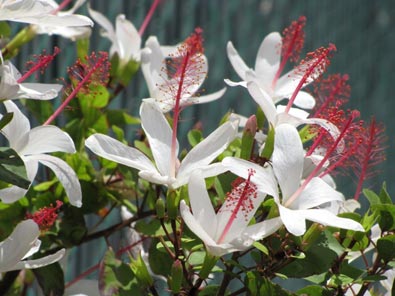
The hauhele par excellence among the Hawaiian plants is Hibiscus arnottianus, which in the season is covered with starry white blooms reminiscent of its Māori namesake, although the Hawaiian flowers are much larger; the two species belong to different genera, but are within the same botanical family. H. arnottianus (also known as koki'o ke'oke'o, koki'o kea, and pāmakani) grows as a shrub or small tree up to 8 m or more, with oval tapered leaves of varying sizes from 4 x 2 cm in length and breadth to as much as 30 x 25 cm. The mildly fragrant flowers have flaring white petals up to 13 cm long, which do not overlap, sometimes turning pink as they age, with the pink or red column bearing the stamens protruding up to 19 cm. The tree is found naturally in moist to wet forest between 100 to 800 m. above sea level on the islands of O'ahu and Moloka'i. There are three recognized subspecies: s. arnotttianus, found in some montane haitatats on O'ahu, s. immaculatus, very rare in the wild but surviving in some mountain valleys on Moloka'i, and s. punaluuensis, a vigorously growing variety found at altitudes of 200-700 m. at locations on the Ko'olau mountain range on O'ahu.

Hibiscus brackenridgei, the ma'o hau hele (placed by some botanists in the genus Sabdariffa) with its brilliant yellow flowers was named the State Flower of Hawai'i in 1988. As a shrub it has a sprawling habit and grows to about 3 m. high, or as a small tree it can reach as high as 10 m. The young branches may be partly covered with reddish or yellowish hairs rising from small swellings (pustules). The leaves are broadly circular and deeply lobed -- 3, 5 or 7 lobes to a leaf (sometimes the lobes overlap). The leaves are 5 -15 cm. long and wide, with stalks about half the length of the leaf. The leaves leave a scar on the stem when they drop. The bright yellow petals have a maroon spot at the base; they are 4-8 cm. in length, spreading, with a protruding staminal column.

This species was once cmmon in dry forest from 100 to 800 m. on all the main islands of Hawai'i, but is now rare in the wild. Like the hau on the seashore, the ma'o hau hele can form impenetrable thickets, although these now are seldom encountered. When it was more plentiful, a yellow-green dye was made from the leaves and flowers.

The hau hele 'ula -- Kokia spp.

Kokia cookeiLike the hau kuahiwi (Hibiscadelphus spp.), members of the Kokia genus, known collectively as koki'o and hau hele 'ula (crimson hau hele), are close to vanishing. One of the four species is extinct, and the other three are endangered. One of them, Kokia dryanarioides, has been saved from extinction by the Amy Greenwell Ethnobotanical garden, which has raised thousands of seedlings and distributed these to conservation projects and gardeners. Wildfires, feral goats, and changes in land use had reduced this species to four plants in the wild by the 1990s.

Kokia dryanarioides grows up to 8 m. tall with lobed leaf blades 8 - 20 cm. wide, sometimes with nectaries (small nectar-producing structures) along the major veins. The flower has scarlet petals up to 11 cm. long with the column bearing the stamens about 11 cm. long.

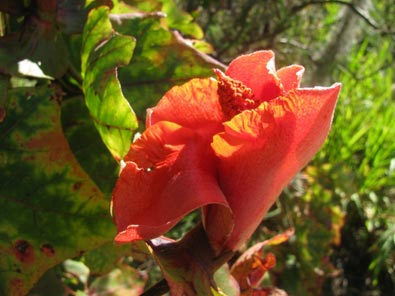
Kokia cookei was endemic to Mokola'i, but is now exinct in the wild and attempts to revive it from seedlings have not been successful. Most plants in botanical gardens are grafted on to K. kauaiensis, also extinct in the wild. K. cookei grows 3 - 5 m. tall, with lobed leaf blades 5 - 13 cm. wide. The spectacular flowers (above, left) have orange-red petals, 8 cm. long by 6 cm. wide.

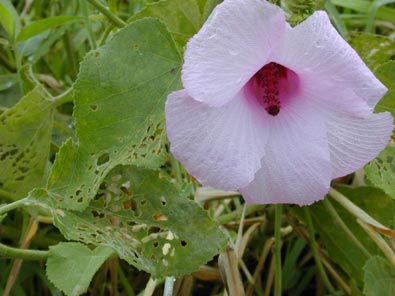
The hau hele wai -- Hibiscus furcellatus

Like its New Zealand counterparts, the hau hele wai "water hau hele" is a herb. It has been placed in the genus Sabdariffa by Barrett et al. (2025), but this revision has not yet been accepted universally by botanists. The species is native to Hawai'i, but found also in the West Indies, Florida and Central and South America. It grows in wet, disturbed areas (hence the name hau hele wai) in Kauai, Hawai'i and O'ahu, but was once common in many more valleys and sheltered places than it is now. It grows from 1 to 2.5 m. tall and has lobed oval or circular leaves 5-15 cm. long and wide. Its flowers are borne singly on the bases of the upper leaves, or along racemes (flower stalks). The petals are 5 to 9 cm. long, pale magenta or rose with deeper colouring towards the base. They do not open very wide.

*Fausele in Rarotonga

Grewia prunifolia belongs to a genus previously classed with the Tiliaceae (the linden family), and later the Sparrmanniaceae, but many botanists now regard it as a member of the Malvaceae, like the Hibiscus. These plant families had more in common than separating them, and the "prototypical" hau, Hibiscus tiliaceus, has a scientific name alluding to its linden-like qualities. Grewia prunifolia is known as fau ui in Samoa, and fo'ui in Tonga. In both those countries its stems are used for starting fires by friction. Although it also indigenous to the Cook Islands it is now rare and not used there as a substitute for matches -- or for making hats. There is a fuller description of this plant on the page for *Fauqui.


Hauhele
Kokia drynarioides - Hauhele 'ula, Kokia
(Kula, Maui, Hawai'i. Photo: (c) Forest & Kim Starr)

Hauhele
Hibiscus arnottianus - Hauhele
(Kahului, Maui, Hawai'i. Photo (c) Forest & Kim Starr)

Hauhele
Grewia prunifolia - 'Au'ere
(Rarotonga. Photo: (c) Gerald McCormack, CIBP)
Hauhele
Hibiscus furcellatus - Hauhele wai
(Nahiku, Maui, Hawai'i. Photo: (c) Forest & Kim Starr)

Tapa-Samoa
Hoheria populnea - Houhere
(Te Māra Reo, Waikato, NZ. Photo: R.B.)

Fou hele
Abutilon indicum - Fou hele (Niue)
(Photo: (c) Bō-á-tún ê hoe (Wikipedia))
Further information : See the Bibliography for references to works on Hawaiian, Cook Island, Marquesan and New Zealand trees, and publication details of the paper mentioned in the text. There is a page of photographs on the Endemia website dedicated to the flora and fauna of New Caledonia, which has a series of photographs of Grewia prunifolia under the synonym of G. persicifolia. The Cook Islands Biodiversity Database also has information about this species.
Photographs: The inset photographs of [1] Hibiscus tiliaceus, evening mode, and [2] Kokia cookei were taken by (c) Prof. G. D. Carr, University of Hawai'i, Mānoa. The others are acknowledged in the captions. We are grateful for the permission of the photographers to use their photographs..

Citation: This page may be cited as: R. A. Benton (2026) "Proto-Polynesian *Fausele and its cntemporary reflexes" (web page periodically updated), Te Māra Reo. "http://www.temarareo.org/PPN-Fausele.html" (Date accessed)

(Hoki atu ki runga -- Go back to the top of the page.)


Te Mära Reo, c/o Benton Family Trust, "Tumanako", RD 1, Taupiri, Waikato 3791, Aotearoa / New Zealand. This work is licensed under a Creative Commons Attribution-Noncommercial 3.0 New Zealand License