PROTO-POLYNESIAN ETYMOLOGIES
*Fau [Proto Polynesian]
Hibiscus tiliaceus, "Beach Hibiscus" (Malvaceae).
From PROTO MALAYO-POLYNESIAN *baRu, Hibiscus tiliaceus , "Beach Hibiscus" (Malvaceae).
through PROTO OCEANIC *paRu, Hibiscus tiliaceus;
and PROTO OCEANIC *vaRu, Hibiscus tiliaceus.

Proto Nuclear Polynesian: *Fau
REFLEXES IN SOME POLYNESIAN LANGUAGES:
Tongan: Fau (Hibiscus tiliaceus, "Beach Hibiscus", Malvaceae);
Samoan: Fau (Hibiscus tiliaceus);
Rapanui: Hau ("Thread, fibre");
Marquesan: Fau ~ Hau (Hibiscus tiliaceus);
Hawaiian: Hau (Hibiscus tiliaceus); Hau kuahiwi (Hibiscadelphus spp., Malvaceae);
Tahitian: Hau, Fau (Hibiscus tiliaceus); Fau tū, Fau ti'a (Abelmoschus moschatus, Malvaceae)
Tuamotuan: Fau (Hibiscus tiliaceus);
Rarotongan: 'au (Hibiscus tiliaceus);
Māori: Whau (Entelea arborescens, Malvaceae); Whauwhau, Whauwhaupaku (Pseudopanax arboreus, Araliaceae).

Fau
Hibiscus tiliaceus - Fau
(Palolo Marine Reserve, Apia, Samoa. Photo: S.A.)
Fau
Hibiscus tiliaceus - Fau
(Palolo Marine Reserve, Apia, Samoa. Photo: R.B.)

COGNATE REFLEXES IN SOME OTHER AUSTRONESIAN LANGUAGES
Ilocano (Philippines): bago (Hibiscus tiliaceus, "Beach Hibiscus", Malvaceae);
Tagalog (Philippines): balibago (Hibiscus tiliaceus);
Gitua (North New Guinea): paru (Hibiscus tiliaceus);
Mota (Vanuatu): varu (Hibiscus tiliaceus);
Fijian: vau (Hibiscus tiliaceus).

RELATED WORDS
Proto-Polynesian: *Fausele (Hibiscus variety or Hibiscus-like tree); *Fauqui, Grewia prunifolia (Malvaceae).
Māori: *Houhere (Hoheria populnea, Malvaceae); Houhi, Whauwhi, Houi, Hoheria & Plagianthus spp. (Malvaceae)


Introduction
Hibiscus tiliaceus
The Fau Tū, Abelmoschus moschatus
The Hau Kuahiwi -- Hibiscadelphus species
Gallery

The tree most often referred to by reflexes of this word and its ancient Proto-Malayo-Polynesian antecedent, Hibiscus tiliaceus, is as useful as it is widespread. The name itself, although undergoing evolutionary changes as it travelled with the Austronesian explorers from the Philippines to Polynesia, retained its meaning intact until it reached the ends of the earth, Hawai'i, where it was probably brought by the first Polynesian settlers to join the indigenous Hibiscus species, and to Rapanui and Aotearoa, where the "beach hibiscus" was not found, but the memories of its attributes remained and are reflected in the new referents.

Hibiscus tiliaceus

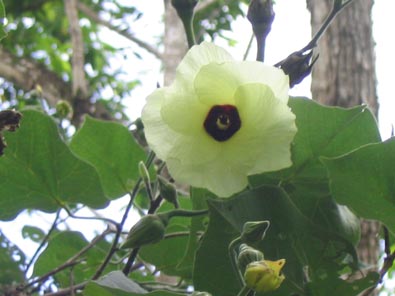
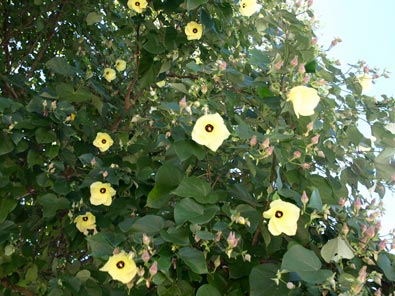
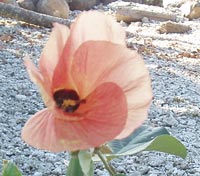
Hibiscus tiliaceus grows 10 to 15 m high, often with layered and intertwined branches. Its heart-shaped leaves, green above and grey below, are up to 17cm long and 22 cm in diameter, or even larger on some plants. The petioles (leaf stalks) are 3 to 15 cm long, depending on the size of the leaf. The flowers are borne on panicles at the tips of the branchlets, each with 5 overlaping petals up to 10 cm long by 8 cm across. One of the fascinating qualities of Hibiscus tiliaceus is the way its flower changes colour as the day progresses, deep red in the bud, opening bright yellow in the morning (as in the photographs at the top of this page and the gallery below) with bright yellow stamens fused around the style, fading to a pale pink or crimson at the end of the day (as in the picture to the left), with a dark pink or purple-red base, before the petals drop and carpet the sand or float upright in the adjacent water. Adrienne Kepler (Hawaiian Heritage Plants, p. 74) notes that in Hawaiian tradition the bloms are symbolic of the transitoriness of life. The fruits are yellowish capsules which open along five seams, containing kidney-shaped seeds able to float for considerable periods of time.

Hibiscus tiliaceus is a tree of the seashore, but is also found inland especially in marginal and disturbed areas to several hundred metres above sea level. S.H. Sohmer and R. Gustafson note that in Hawai'i it has been associated as a dominant tree in mesic areas (places neither very wet or very dry) for the last thousand years with two Polynesian imports, Thespesia populnea (milo) and Aleurites moluccana (kukui -- candlenut). It is still planted (using cuttings or seeds) for windbreak hedges and to stabilize coastal soils.

The botanist William Sykes (Flora, p.698) regards Hibiscus tiliaceus as the most common tree in the Cook Islands, probably native to Rarotonga and other islands in the Southern Cooks, but introduced to the northern atolls. In the Cooks and Hawai'i (and elsewhere) it forms impenetrable thickets in in many gullies and along forest margins. In Rarotonga it is found from sealevel to 250 m.

In Samoa it is common to abundant in littoral forests, mangrove swamp margins and disturbed secondary forests from sea level to 650 m. It often forms thickets in previously disturbed areas.

The soft, tough wood bends but does not readily break, and lasts well in sea water. In Samoa and other parts of the Pacific the wood is used for house and canoe parts, tool handles, fishnet floats, carrying sticks and firewood. Poles from straight stems are strong, light-weight and excellent with an angled cross-piece lashed to the top for making breadfruit-pickers, and smaller pieces sharpened at one end make good breadfruit splitters. The coarse fibre is used for ropes, also mats, sandals and "grass skirts" (a modern use in Samoa for the benefit of tourists, originating (according to Adrienne Kepler) with imports from the Gilbert Islands; use of the finer inner fibre for this purpose was standard practice in Tahiti. Hau fibre is also good for foot nooses for climbing coconut trees. Although it is very strong, however, the fibre even when woven into heavy-duty ropes is not completely water-resistant and so may lack durability. Nevertheless it can be used successfully for fishing lines. In Hawai'i, the rougher outer fibre was mostly used; Tahitians traditionally made more use of the softer, inner fibre. The sap has some medicinal uses and the leaves can be used to wrap food, or as toilet paper. In Samoa (and no doubt elsewhere) the fibres were also used for making strainers for coconut milk. For a while in the 19th Century the fibres were also exported from Hawai'i to Jamaica for stuffing cricket balls. Strips of bark were also used in making clothing and in binding elaborate leis.

In Hawai'i the beach hibiscus is mentioned in second chant of the Kumulipo, dealing with the emergence of water creatures and their terrestrial guardians:

'O kāne ia Wai'ololi, 'o ka wahine ia Wai'olola,
Hānau ka Pāhau, noho i kai,
Kia'i ia e ka Lauhau noho i uka.
Man for the narrow stream, woman for the broad stream,
Born is the Pāhau living in the sea,
Guarded by the Hau tree living on land.

The pāhau is a striped flatfish, found in shallow waters adjacent to the hau's typical habitats.

The mention in the Kumulipo underlines the importance of the hau in traditional Hawai'ian culture. Isabella Abbott (Lā'au Hawai'i, p.62) notes that the cordage made from the fibres was valued for many purposes, from lei making to hauling logs from the mountains to canoe houses on the coast. The hau and wiliwili (Erythrina sandwicensis) were the only softwoods used in canoe manufacture -- for booms and floats for the outriggers because of their light weight and bouyancy. The hau had sacred as well as practical significance. Adrienne Keppler (Hawaiian Heritage Plants, p.73) reports that branches placed along the shoreline marked a rāhui while small fish were developing in shallow water before migrating to regular feeding grounds. David Malo notes that when an army went into battle, a priest went ahead carrying a branch of the hau tree.

This was set upright in the ground by the priest and guarded in that position by him as a favourable omen or sign for his side. Each side religiously respected the emblem of the enemy and did not interfere with their mihau [symbolic hau branch]. So long as the branch was kept erect it meant victory to its side.If the battle finally went against them, the hau was allowed to fall. There was a proverbial expression "Ua puali ka hau nui i ka hau iki." (The great hau is broken by the small hau") meaning the large force is defeated by the small. (Hawai'ian Antiquities p. 199).

'Olae'ulaThroughout the tropical Pacific the hau is also valued as a "fire stick". Isabella Abbott (Lā'au Hawai'i, p. 93) recounts how her mother had taught her to use hau for making fire. A pointed piece of hau was rubbed against a harder wood -- traditionally olomea (Perrottetia sandwicensis) but in her case kukui (Aleurites moluccana). The harder wood causes particles to break off the softer hau, the friction causes these to heat up, smouder, and eventually burst into flame. In Haraiian tradition Maui had obtained the secret of fire making from the 'olae 'ula bird (Gallinula galeata sandwicensis, a moorhen rather like the pūkeko). A group of them had been cooking bananas and Maui and his brothers had seen the smoke. After several unsuccessful attempts to observe what was going on, eventually Maui managed to capture one of the birds, and rubbed its head until it started to bleed -- hence the red head feathers of the 'olae 'ula now -- they were fomerly white. The bird finally told Maui how the fire-making was done, and he passed the information on to humans.

Dr Abbott notes various medical uses for hau (which are parralleled in other parts of Polynesia): the sap was used as an internal lunricant, for example as an enema, and also to assist the passage of the fetus through the birth canal. A mixture of the sap and flowers was used as a mild laxitive. The sap was also incorporated in eye drops, and applied to cuts. A poultice of crushed young leaves was sometimes applied to burns. In Tonga Art Whistler noted that the mucilage from the bark was used for treating eye ailments (Tongan Herbal Medicine, p. 64), and an infusion of the bark was also used for treating stomach ache.

Art Whistler noted that Hibiscus tiliaceus was one of the most important non-food trees in Tahiti. This is borne out by Te Uira Henry's account of the plant's importance in "Ancient Tahiti". Te Uira Henry noted that Tahitians distinguished several varieties of the species, including: pūrau ahue, straight and erect; pūrau-ma-ohi, with large leaves, used for wrapping foods; and pūrau-papa, a sterile variety that grows on rocks. In common usage, the word pūrau had replaced the ancient terms hau and fau as the name of the plant, but she says (p. 53) that the leaves are always called rau-fau and puapua-fau. Tahitians used the inner wood processed by being steeped in water for crates for carrying fruits and livestock. The mature wood of the straight variety was used for boat building, oars and planks, as well as canoes and paddles. Bark stripped off the stems, soaked in watr for several days and bleached in the sun produced a valuable white fibre for cords, ropes and "fringes" Once, it was braided into clothing. She records that Hibiscus species with similar properties were also called fau, but never pūrau.

The Fau Tū, Abelmoschus moschatus.

Abelmoschus In Samoa fau tū is a synonym for fau as Hibiscus tiliaceus. However in Tahiti fau tū or fau ti'a were old expressions referring to the Musk Mallow, Abelmoschus moschatus, also known as Hibiscus abelmoschus. This is a tough, hairy "subshrub", a metre or more tall, with sturdy branches and brilliant yellow flowers with a dark purple base. It is found in marginal areas aound plantations and in moist areas in valley bottoms and other disturbed sites. This plant is not mentioned in Art Whistler's Plants of the Canoe People, but he does describe it as a Polynesian introduction in Ethnobotany of the Cook Islands and (as Hibiscus abelmoschus) in the Flora of Samoa. In his Flora Vitiensis Nova Vol 2, the botanist Albert Smith comments that this species is distributed "from India and Southern China through Malesia and into the Pacific; the precise limit of its indigenousness is problematical, but ... I doubt if it is native in Fiji, more likely it was an inadvertent aboriginal introduction" (p. 423). The introduction into Polynesia may have been more deliberate, however, as in the Cook Islands and elsewhere fibre was extracted from its bark to make a high quality twine. In Rarotonga it is known as 'aute, in Mangaia as ta'uri'au, and in the other Southern Cook Islands as vavai tara -- prickly hibiscus, because of its prickly, bristle-like hairs. In Samoa it is known as 'aute Tonga (Tongan hibiscus). The modern name in Tahiti seems to be pūrau papa'ā ("foreigner hibiscus", possibly also because of the bristles) contrary to Te Uira Henry's rule about the use of the word pūrau noted above.

The Hau Kuahiwi -- Hibiscadelphus species

The hau kuahiwi - montane hau - are a group of six species of the genus Hibiscadelphis, endemic to Hawai'i, three of which are now extinct and the others survive only in cultivation. They are victims of specialization and globalization. Their disctictive tubular flowers were curved to enable polination by the Hawaiian honeycreepers, birds with curved bills which enabled them to drink the nectar within the flower while effecting its pollination. However the honeycreepers were bitten by introduced species of mosquitos also carrying introduced species of avian malaria. This was fatal to the birds, and with no pollinators the trees also gradually died out in their natural environments.

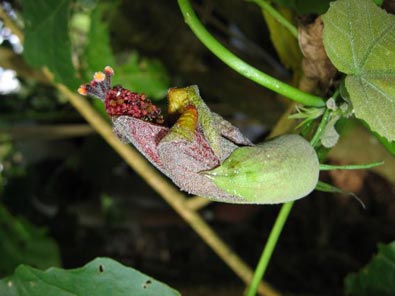
Hibiscadelphus flowerThe three species which survive are Hibiscadelphus giffardianus, H. distans, and H. hualalaiensis. H. giffardianus grows to 7 metres or more tall and has large roundish or somewhat kidney-shaped leaves with very long petioles. The curvey, rolled-up flowers (illustrated on the left and in the gallery below) are greyish-green on the outside and dark magenta within. The last tree known from its natural habitat was found in mesic forest at Kipukapuauhu on the eastern slopes of Maunaloa, Hawai'i in 1911.

Hibiscadelphus distans still hangs on with one or two plants in the wild, near the Waimea Canyon in Kauai. It is a small tree growing to 5 m tall with a rounded crown and a very slender trunk (5-8 cm in diameter). It has oval leaves up to 10 cm. long. Its flowers start as bright green and become a dull reddish colour as they age.

Hibiscadelphus hualalaiensis grows from 5 - 7 m tall, with a much larger trunk than H. distans (up to 30 cm. in diameter). It has oval or roundish leaves up to 15 cm long with petioles up to 10 cm long. There were a few trees known from forest on lava flows on Hualālai volcano in North Kona, Hawai'i, but few if any trees survive there now. You can see this species growing in the Amy Greenwell Ethnobotanical Garden.

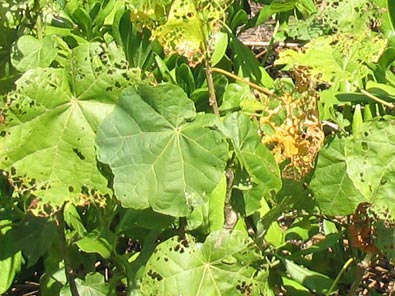
Like those of some Hibiscus species, Hibiscadelphus leaves seem to be a favourite food of certain chewing insects.

(Hoki atu ki runga -- Go back to the top of the page.)

Gallery

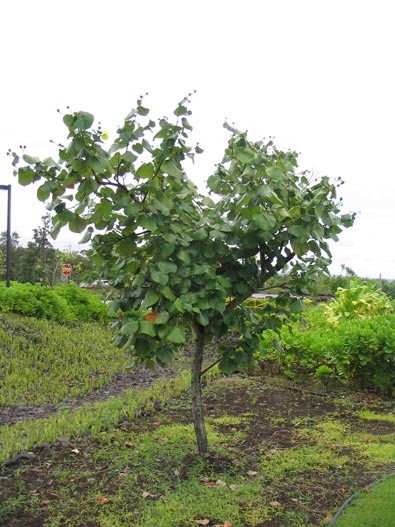
Solo Hau
Hibiscus tiliaceus - Hau
(Honoka'a, Hawaii, Photo: R.B.)

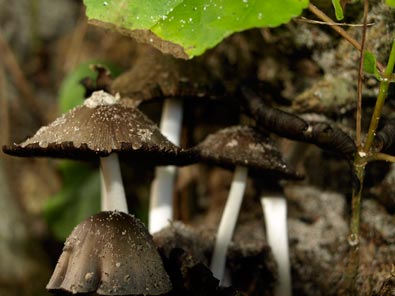
Fungi with Fau
Mushrooms growing at base of Hibiscus tiliaceus - Fau
(Siumu, Upolu, Samoa. Photo: R.B.)

Hibiscadelphus
Leaves of Hibiscadelphus sp. - Hau kuahiwi
(Kilauea Forest Park HQ, Hawaii. Photo: R.B.)

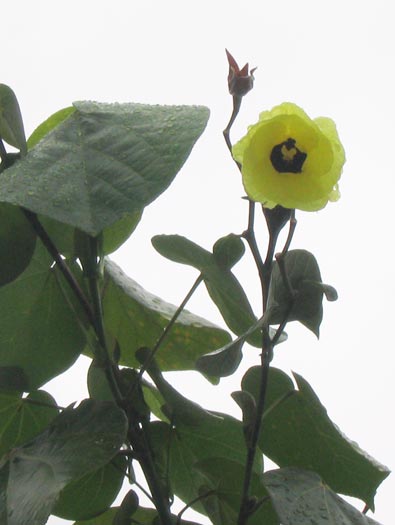
Hau reaching for the sky
Hibiscus tiliaceus - Hau
(Honoka'a, Hawaii; close-up of flower in photo on the left. Photo: R.B.)

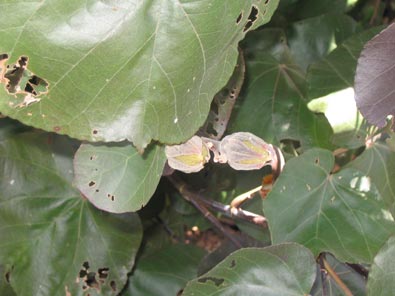
Hau-leaf edges
Leaves and unopened flower buds of Hibiscus tiliaceus - Hau
('Imiloa Planetarium, Hilo, Hawaii. Photo: RB)

Hau-leaf edges
Flower of Hibiscadelphus giffardianus - Hau kuahiwi
(Kīpuka Puaulu, Hawaii Volcanoes National Park, Hawaii. Photo (c) Karl Magnacca)

Further information : The information on this pages has been drawn from fieldwork in Hawai'i and Samoa, and books and papers relating to plants in various parts of Polynesia, particularly the Plants of the Canoe People and other works by W. A. Whistler, David Malo's Hawaiian Antiquities, Adrienne Kepler's Hawaiian Heritage Plants, Isabella Aiona Abbott's Lā'au Hawai'i, W. Wagner et al. Manual of the Flowering Plants of Hawai'i, Te Uira Henry's Ancient Tahiti, along with other works quoted in the text, all of which are listed in the Bibliography. The Cook Island Biodiversity Network Database, Ken Fern's Useful Tropical Plants database, and Wikipedia are good places to start looking for further information about the tropical plants on line.

Photographs: The inset photos are [1] Hibiscus tiliaceus flower, late afternoon, Palolo Marine Reserve, Apia, Samoa (Photo: R.B.); [2] Hibiscus tiliaceus flower and foliage, and [3] flower buds and floiage, Titikaveka, Rarotonga (Photos: (c) Peter de Lange, NZPCN); [4] the 'olae 'ula bird, Gallinula galeata sandwicensis (Photo: (c) Keri Rouse, Hawai'i Department of Land and Natural Resources); [5] Abelmoschus moschatus flower, flowerbuds and foliage, Rarotonga (Photo: (c) Gerald McCormack, CIBP); [6] Hibiscadelphus giffardianus flower (Photo: (c) G. D. Carr, University of Hawaii). The other photos are acknowledged in the captions. We are grateful to all the photographers for allowing us to use their work.

(Hoki atu ki runga -- Go back to the top of the page.)

Citation: This page may be cited as: R. A. Benton (2026) "The Proto-Polynesian plant name *Fau and its contemporary connections" (web page periodically updated), Te Māra Reo. "http://www.temarareo.org/PPN-Fau.html" (Date accessed)


Te Mära Reo, c/o Benton Family Trust, "Tumanako", RD 1, Taupiri, Waikato 3791, Aotearoa / New Zealand. This work is licensed under a Creative Commons Attribution-Noncommercial 3.0 New Zealand License