| PROTO-POLYNESIAN ETYMOLOGIES |
| *Kulu |
Artocarpus edulis , "Breadfruit" (Moraceae). |
|
From
PROTO MALAYO-POLYNESIAN *kuluR, Artocarpus altilis , "Breadfruit" (Moraceae).
through PROTO OCEANIC *kulur, Artocarpus altilis. |
Proto Nuclear Polynesian: *Kulu
REFLEXES IN SOME POLYNESIAN LANGUAGES:
Samoan: 'ulu (Artocarpus altilis, "Breadfruit", Moraceae)
Marquesan: Ku'uvahake, ku'uvahane (Varieties of Artocarpus altilis)
Hawaiian: 'ulu (Artocarpus altilis)
Tahitian: 'uru (Artocarpus altilis)
Tuamotuan: Kuru (Artocarpus altilis)
Maori: Kuru, A sheltering fruit tree which grew in Hawaiki, thought to have been Artocarpus altilis.
|

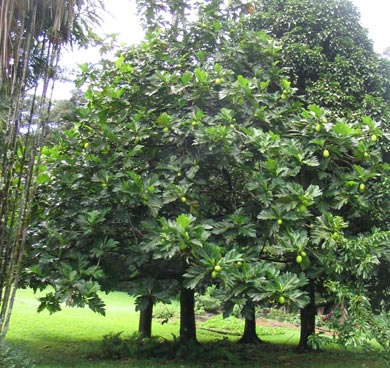
(Above) Fruit and leaves of kulu (Breadfruit)
(Right) Grove of Artocarpus altilis (Breadfruit)
Honolulu, Hawaii |
 |
|
|
COGNATE REFLEXES IN SOME OTHER AUSTRONESIAN LANGUAGES
Malay and Javanese: Kulur (Seed-bearing varieties of Artocarpus altilis, "Breadfruit", Moraceae)
Mussau (Admiralty Islands, PNG): Ulu (Artocarpus altilis)
Wayan Fijian: Kulu (Artocarpus altilis) |
|
|
|
Words derived from Proto Malayo Polynesian *kuluR, like the breadfruit itself, are used in many parts of Southeast Asia and Polynesia. However they are absent in Philippine languages, where the most common term is rimas. In some Vanuatu, Micronesian and Polynesian languages "breadfruit" is denoted by words inherited from Proto Remote Oceanic *maRi; these include the Tongan and Marquesan words, mei. Although the Wayan Fijian term kulu is inherited from Proto Malayo-Polynesian *kuluR, the Bauan term is uto.
The Samoan word is 'ulu, cognate with Māori kuru. The tree is still widely grown in Samoa, and the fruit features in a proverb (quoted by the former Head of State Tui Atua Tupua Tamasese in a speech to a mental health group in 2018) reminding us of the importance of paying attention to details -- what appear to be periperal matters may still merit close attention:
Lou muamua le ulu taumamao.
Pick the breadfruits on the far-off branches first.
Three additional words associated with breadfruit have survived in modern Maori. One is now associated with another very important traditional source of food, the raupō:
Hune, "pappus [the downy appendage on the flowering stem] of raupō", from Proto Nuclear Polynesian *fune "downy core of breadfruit";
Proto-Polynesian *Fune "downy, furry; the downy core of the breadfruit"
Cognate words in some other Polynesian languages:
Samoan: Fune, "male catkin of breadfruit;"
Tokelauan: Fune, "core of breadfruit;"
Tahitian: Hune, "core of breadfruit;"
Tuamotu: Hune, "core of breadfruit or pandanus;"
Rarotongan: 'une, "core of breadfruit."
The others are:
Pē, pēpē, "soft, crushed, mashed; soft mass ", from Proto Polynesian *peqe "over-ripe, soft (of breadfruit) ";
Proto-Polynesian *Peqe "downy, furry; the downy core of the breadfruit", from:
Proto Oceanic *peqe (*mpeqe) "over-ripe"
Cognate words in some other Polynesian languages:
Tongan: Pe'e, "over-ripe, soft (of breadfruit);"
Samoan: Pē, "over-ripe, soft, easily crushed ;"
Tokelauan: Pē, "rotten, over-ripe breadfruit;"
Hawaiian: Pē, pēpē , "crushed;"
Tahitian: Pē, "decayed, rotten, worn out; ripe (fruit);"
Tuamotu: Pē, "over-ripe;"
Rarotongan: Pē, "rotten, decayed; over-ripe, soft, easily crushed;"
Moriori: Pē, "rotten, wet."
and, less directly, puru, pupuru , "pulpy, thick, stiff; also plug, caulking for a canoe", from Proto Polynesian *puru "gum, resin";
Proto-Polynesian *Pulu "gum, resin", from:
Proto Austronesian *Belit ~ *bulit "thick, sticky"
Proto Oceanic *bulut ~ *bulit "sap of plant or other sticky substance; be sticky"
Cognate words in some other Polynesian languages:
Tongan: Pulu, "sap;"
Samoan: Pulu, "gum, resin;"
Tahitian: Puru, "thick (of liquid); viscous, clotted;"
Tuamotu: Pupuru, "viscous, clotted;"
Rarotongan: Puru, "sticky."
There is one more Māori word included in the Pollex database which may have "breadfruit" connections. This is Piere "fissure", possibly connected in some convoluted way with Proto Central Eastern Polynesian *Piere "grated breadfruit, banana or taro pudding"; however the Māori word and a Tuamotuan word with a similar meaning are probably the surviving reflexes of a Proto-Tahitic word for "fissue, gap", unconnected semantically with the other *piere.
Proto Central Eastern Polynesian *Piere "a pudding made from breadfruit, banana, or taro, baked in tī leaves with coconut cream"
Cognate words in some other Polynesian languages:
Hawaiian: Piele, "pudding of grated taro, kumara, yam, banana or breadfruit;"
Mangareva: Piere, "breadfruit peeled, wrapped in banana leaf, and baked in oven;"
Tahitian: Pīere, "bananas preserved by drying in the sun;"
Rarotongan: Piere, "'banana figs' - bananas peeled and dried in the sun."
Similar words probably reflexes of a separate, non-cognate Proto-Tahitic word:
Tuamotu: Piere, "split open, gape, hang open ;"
Maori: Piere, "fissure."
Watch this space for more information about this amazing tree and food crop! |
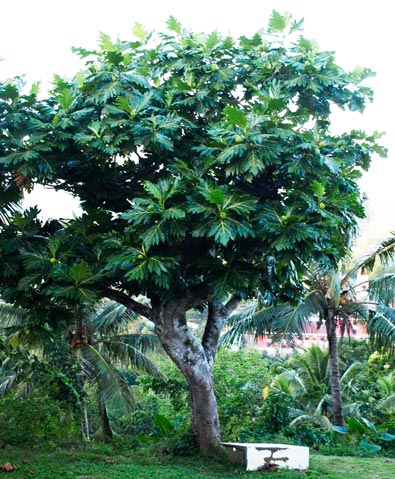
Kulu (Artocarpus altilis), Apia, Samoa |
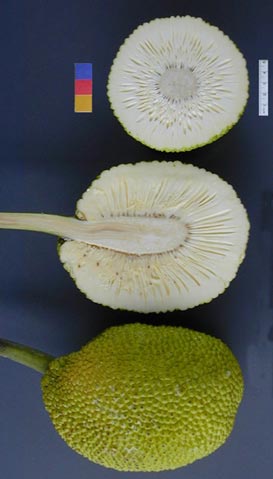
Breadfruit (*Kulu) Whole fruit and sections. |
|
| Further information: There is a very comprehensive discussion of words denoting breadfruit in Oceanic languages, as well as information about the tree and its fruit, in The Lexicon of Proto Oceanic, Volume 3 (see Bibliography). |
| Photographs: Sections of breadfruit: US Pacific Basin Basin Agricultural Research Centre. Others, R.B. |
|
|